Bring your own infrastructure
Connect Linux, macOS, Windows, Proxmox, bare-metal, and cloud capacity as clusters that can schedule sandbox workloads on hosts you control.
Infrastructure
Infra is the secure execution foundation beneath Products and Studio. Start with machines you operate, add managed capacity when needed, and keep one control plane for placement, networking, storage, access, and recovery.
Connect Linux, macOS, Windows, Proxmox, bare-metal, and cloud capacity as clusters that can schedule sandbox workloads on hosts you control.
Install gstacks and gstacks-agent on Linux ARM64 and macOS ARM64 hosts, including Apple Silicon machines.
Attach shared sandbox volumes backed by JuiceFS so files can follow workloads through the agent-managed volume path.
Host agents join a Tailscale-compatible mesh for cluster reachability, health, and data-plane coordination without exposing infra endpoints to sandboxes.
Attach sandboxes to managed networks with stable DNS aliases and virtual addresses while agents enforce policy and proxy traffic.
Open browser or CLI terminal sessions for connected hosts and sandboxes through the agent-backed terminal path.
Use managed OpenSSH config for sandbox aliases, join a sandbox network from the CLI, and forward service aliases to localhost.
Deployment model
The control plane treats connected hosts as schedulable infrastructure beneath Products and Studio. Hosts can be eligible for sandbox placement, host access, or both, and routing labels make placement explicit instead of relying on fragile naming conventions.
The GlobalStacks platform subscription is $10 per month with an annual commitment or $12 with monthly flexibility. It includes Studio, Products, Infra, five connected host slots, and unlimited clusters. Use BYO, shared managed, dedicated managed, or combine them across environments.
Release artifacts include Linux ARM64 and macOS ARM64 builds for both the CLI and host agent, so ARM Linux boards, servers, and Apple Silicon Macs can participate in the same BYO cluster model.
Host agents join Tailscale-compatible mesh networks for cross-agent reachability. Sandbox workloads stay behind the agent boundary and reach services through GlobalStacks DNS names, virtual loopback addresses, and policy-checked proxies.
Operators can open host and sandbox terminals in the browser or from the CLI. Developers can also use OpenSSH gateway aliases for sandboxes and `gstacks mesh forward` to expose a network alias on localhost during development.
Proxmox deployments use API-backed OCI container import and rolling target selection. Product operations stay on typed APIs and agent RPCs instead of SSHing into control-plane machines.
OCI provides the portable baseline for service runtimes, while typed file artifacts preserve target-specific delivery for static bundles, binaries, installers, archives, and other outputs that should not be forced into an image. Explore the deployment model.
Infrastructure for owned operations
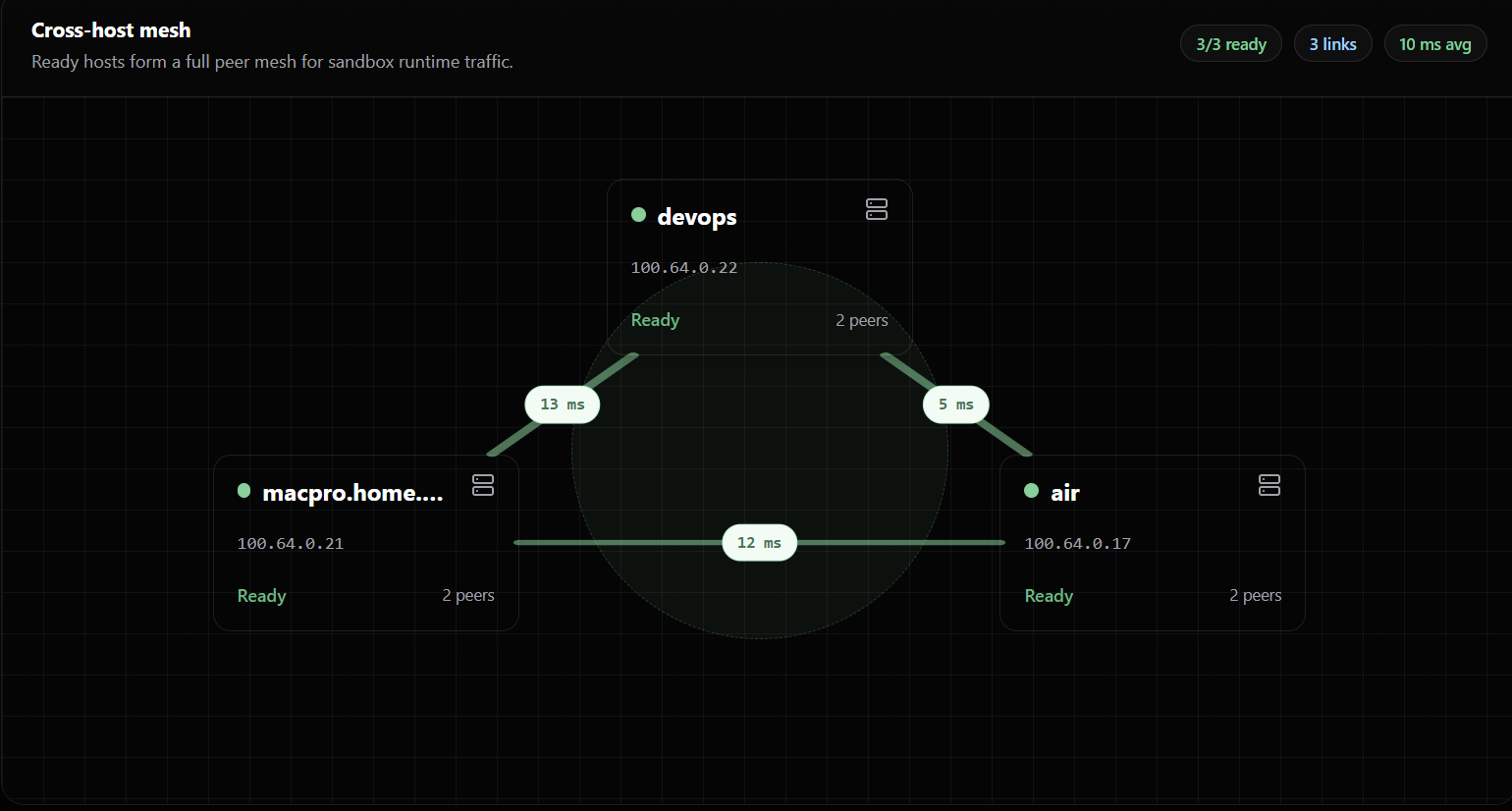
Agents form a private mesh for clustering, placement, health, and control-plane coordination across hosts.